
Disclaimer
The below is a recounting of our first encounter with a feral and the process of successfully acclimating him to inside life and does not necessarily reflect best practices. At the time we met him we knew nothing about trapping and did not have access to a humane trap or know anyone that did. Ideally, spaying and neutering would come a lot sooner in the process. Nonetheless what follows will still apply.
So you met a feral
The first interaction you have with a feral cat will likely be very brief and at some distance. Our first interaction with Marm was just that. He likely spotted us well before we spotted him. He watched us for signs of a threat and soon got uncomfortable when he realized that he had been spotted.
Don't pursue the cat. By letting him set the terms of the interactions to begin with, he learns that you will respect his boundaries. Throughout your interactions though, you will occasionally need to reassure him of this as your relationship changes.
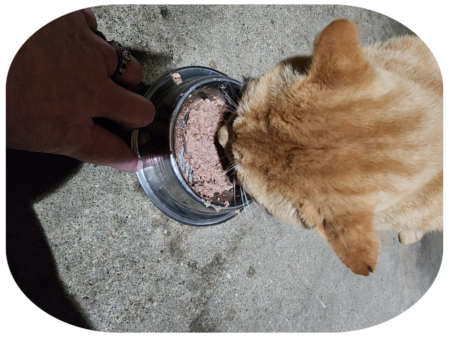
If you set out food, put it in a place where there are plenty of directions to approach and leave so that the cat won't feel trapped. If possible, make sure to put it somewhere that it will be protected by the weather, and then be patient and as consistent as you can be with providing food and clean water.
Don't pursue the cat. By letting him set the terms of the interactions to begin with, he learns that you will respect his boundaries. Throughout your interactions though, you will occasionally need to reassure him of this as your relationship changes.
If you set out food, put it in a place where there are plenty of directions to approach and leave so that the cat won't feel trapped. If possible, make sure to put it somewhere that it will be protected by the weather, and then be patient and as consistent as you can be with providing food and clean water.

Patience and consistency is key
There's likely to be a lot of times where you feel as though you are not making any progress. You may spot the cat just as he disappears into shadows, or he may flee the moment you give even the slightest indication of moving towards the food or water bowls for a refill. This won't last forever, but these are the times where patience and consistency are pivotal. Ferals are used to living on high alert so they will be actively watching for signs of danger. It will take time to undo habits formed over a lifetime of living in survival mode.
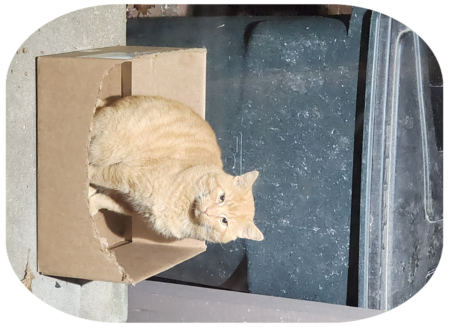
You may want to offer small things like a box to the cat as a gesture of goodwill. Don't be offended if the feral either ignores the box entirely or doesn't seem to have much interest in it initially. You're likely introducing something that is completely foreign to them and while we know that most cats prize a good cardboard box, a feral may initially take it as a trap and steer clear for a while until they are sure that it is benign.
You may want to offer small things like a box to the cat as a gesture of goodwill. Don't be offended if the feral either ignores the box entirely or doesn't seem to have much interest in it initially. You're likely introducing something that is completely foreign to them and while we know that most cats prize a good cardboard box, a feral may initially take it as a trap and steer clear for a while until they are sure that it is benign.
Give time. And then more time.
There will be days where you feel as though you're taking one step forward and three steps back. Where you felt as though things were improving, suddenly the feral will disappear for three nights on end when they had been showing up every night for months. Don't be discouraged. Keep putting out the food and keep doing what you're doing.
Your consistent kindness is making them question what they thought they knew. You're proving to them that not all humans are to be feared or cause harm. During this time, keep your motions calm and steady and refrain from making any sudden movements when possible. Continue to talk to the cat softly whenever they are present.
This back and forth could take years, or it could take days depending on the feline. Each feral is unique and some are more apt to trust than others. Some will watch from a distance and observe your interactions with other cats before you ever even see them directly.
Your consistent kindness is making them question what they thought they knew. You're proving to them that not all humans are to be feared or cause harm. During this time, keep your motions calm and steady and refrain from making any sudden movements when possible. Continue to talk to the cat softly whenever they are present.
This back and forth could take years, or it could take days depending on the feline. Each feral is unique and some are more apt to trust than others. Some will watch from a distance and observe your interactions with other cats before you ever even see them directly.
As much time as the cat needs
We've had cats that aren't ready to trust for approximately three years and others that were ready for pets and to come inside after just days. There are no hard and fast time tables here. Some cats will need more time than others. Watch their body language and listen to their tones. They will let you know when it is okay to push the boundaries of the relationship a little whether by reaching out to offer a sniff of your hand in greeting or by sitting nearby while they eat, etc.
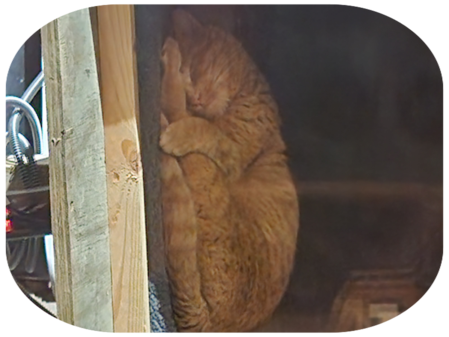
During this time, provision of adequate shelter depending on the season can go a long way in helping them to know that they are safe with you. In summer this may look like a shaded spot with a consistently filled bowl of clean water. In winter, this may look like an ice chest that has been turned into a shelter (there's a how to video here,) or one of the fancy heated mats or houses. What works best for you will depend on what type of weather you have. But as with anything, it will take time for the feline to adjust to the idea of having someone warm. Don't be surprised if the first night they check it out, they only use it for about an hour and then don't touch it again for a night or three. It also helps to offer options. While we regularly get snow in the winter so heated houses would make the most sense to us, we still offer a heated mat is in a more open shelter and cardboard boxes.
During this time, provision of adequate shelter depending on the season can go a long way in helping them to know that they are safe with you. In summer this may look like a shaded spot with a consistently filled bowl of clean water. In winter, this may look like an ice chest that has been turned into a shelter (there's a how to video here,) or one of the fancy heated mats or houses. What works best for you will depend on what type of weather you have. But as with anything, it will take time for the feline to adjust to the idea of having someone warm. Don't be surprised if the first night they check it out, they only use it for about an hour and then don't touch it again for a night or three. It also helps to offer options. While we regularly get snow in the winter so heated houses would make the most sense to us, we still offer a heated mat is in a more open shelter and cardboard boxes.
Expect mood swings
One night the feral will accept your offered hand for a sniff and the next, they will look at your as though you not only offended them but all of their ancestors in reaching out your hand. Don't take offence. Just as humans are sometimes apt to accept hugs from someone and at other times aren't in the mood, the same is true with cats.
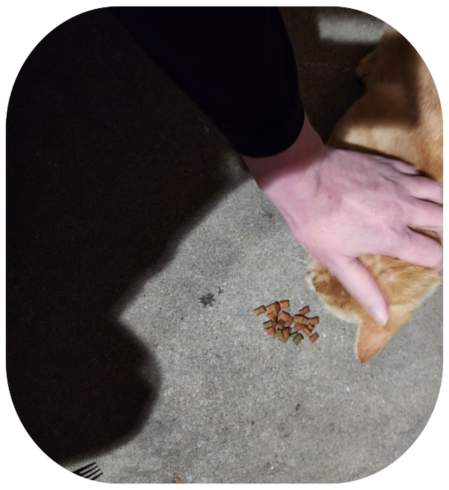
There may be a time when, once they have started to accept pets, they suddenly swipe one night when you pet them in the customary fashion. This is an opportunity for you to reassure them that their feelings do matter by respecting their wishes to abstain from touch that night. Continue to provide for them as you have been to that point, don't force the issue that night, and resume things as normal the next time they come around.
It's also during this time where a cat that has gotten to the point that they willingly accept pets may suddenly disappear for a night or three. Don't fret. They are likely reassuring themselves that they are not in fact being domesticated; that they are choosing whether to hunt or to take an easy meal and that they are still calling the shots.
They've gotten a sample of kind patience though and that's hard to forget.
There may be a time when, once they have started to accept pets, they suddenly swipe one night when you pet them in the customary fashion. This is an opportunity for you to reassure them that their feelings do matter by respecting their wishes to abstain from touch that night. Continue to provide for them as you have been to that point, don't force the issue that night, and resume things as normal the next time they come around.
It's also during this time where a cat that has gotten to the point that they willingly accept pets may suddenly disappear for a night or three. Don't fret. They are likely reassuring themselves that they are not in fact being domesticated; that they are choosing whether to hunt or to take an easy meal and that they are still calling the shots.
They've gotten a sample of kind patience though and that's hard to forget.
The rescue
There will come a time when you find yourself asking, "is it time?"
There could be a number of reasons to take a cat in including injury or illness. But if no health concerns exist, there will likely come a time where the cat will in fact let you know that he is willing to acquiesce to the domestic life.
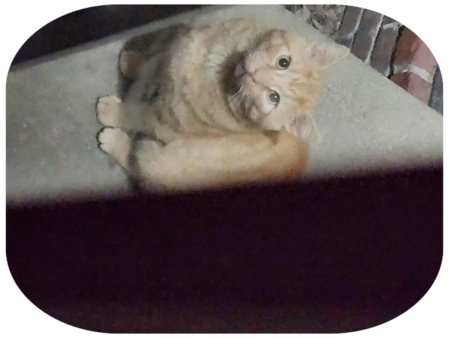
Even if a cat is ready, you may still want to use a humane trap in order to bring them indoors as its a method that is safe for all involved. Just be sure that if you go this route, you follow proper trapping procedures. Not every cat will be like Marm, but it's clearly not out of the realm of possibility. On a particularly cold November night, we marked out a clear pathway in the house that led to the area we were using as a transition suite for cats coming in from the outside and then opened the door. After about ten minutes of back and forth, he walked inside entirely on his own and headed for the suite, leaving the cold and feral life behind.
There could be a number of reasons to take a cat in including injury or illness. But if no health concerns exist, there will likely come a time where the cat will in fact let you know that he is willing to acquiesce to the domestic life.
Even if a cat is ready, you may still want to use a humane trap in order to bring them indoors as its a method that is safe for all involved. Just be sure that if you go this route, you follow proper trapping procedures. Not every cat will be like Marm, but it's clearly not out of the realm of possibility. On a particularly cold November night, we marked out a clear pathway in the house that led to the area we were using as a transition suite for cats coming in from the outside and then opened the door. After about ten minutes of back and forth, he walked inside entirely on his own and headed for the suite, leaving the cold and feral life behind.
Adjusting to indoors
This will look different for each cat rescued but it's likely that once inside there will be a lot of sleeping for the first few days. They're realizing that they are in fact truly safe and may be getting the best sleep of their lives to this point.
Some cats will need assistance in learning to use a litter box. A litter attractant such as Dr. Elsey's Ultra Litter Attractant can be an immense help. But to this end, it is advisable to have such things as Nature's Miracle on hand for the possibility of accidents. It took Marm several days to learn about the litter box and he had accidents during that time. From his disposition though, it was clear that he was more concerned about messing up what he now had than anything else. He just needed a bit more patience and understanding to help him learn what was expected of him.
Once indoors, you will likely discover that there is such a thing as overload. Not only are they safe and comfortable, but they now have nearly unlimited access to toys and pets. This is more direct contact than they have had before and they may get to a point where they are just overwhelmed and either swipe or nip. This is not out of anger or frustration. Pause whatever action you were doing for a bit to let them calm down. Some cats just need a few brief moments, others need closer to half an hour. Watch for body language and listen to their tones to learn whether or not they are still in overload.
Part of adjusting to indoors will also involve a trip to the vet and likely, a trip to get spayed or neutered. The neuter especially, will help their hormone levels decrease and assist in making their transition to the domestic life a smooth one.
Some cats will need assistance in learning to use a litter box. A litter attractant such as Dr. Elsey's Ultra Litter Attractant can be an immense help. But to this end, it is advisable to have such things as Nature's Miracle on hand for the possibility of accidents. It took Marm several days to learn about the litter box and he had accidents during that time. From his disposition though, it was clear that he was more concerned about messing up what he now had than anything else. He just needed a bit more patience and understanding to help him learn what was expected of him.
Once indoors, you will likely discover that there is such a thing as overload. Not only are they safe and comfortable, but they now have nearly unlimited access to toys and pets. This is more direct contact than they have had before and they may get to a point where they are just overwhelmed and either swipe or nip. This is not out of anger or frustration. Pause whatever action you were doing for a bit to let them calm down. Some cats just need a few brief moments, others need closer to half an hour. Watch for body language and listen to their tones to learn whether or not they are still in overload.
Part of adjusting to indoors will also involve a trip to the vet and likely, a trip to get spayed or neutered. The neuter especially, will help their hormone levels decrease and assist in making their transition to the domestic life a smooth one.